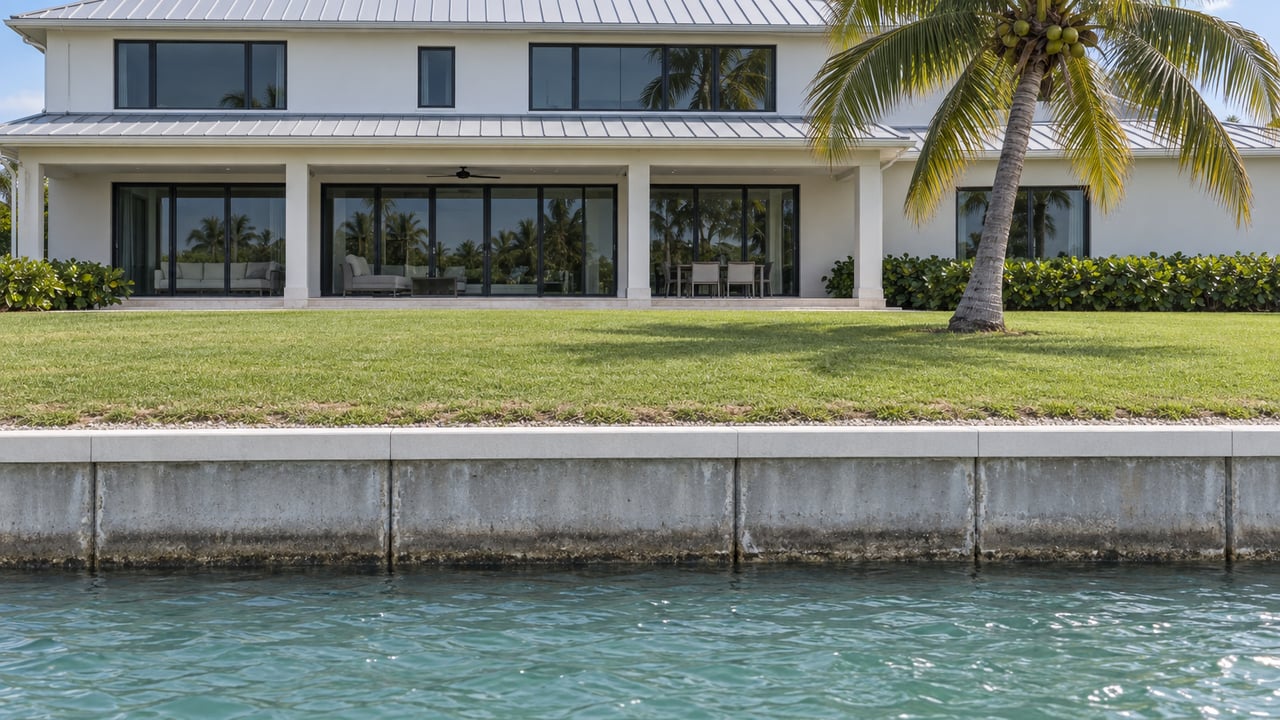
Call a marine contractor about a cracked cap on a canal-front lot in Fort Lauderdale, and the first question they ask isn't about your timeline. It's about linear feet. How much of the wall is actually failing, and how much of it are you planning to touch. That question determines whether you're paying for a patch or funding a full-height rebuild, and it has almost nothing to do with any date on a calendar.
Most owners assume they have years to think about this. According to The National Law Review, Broward County's regional seawall standard phases in a 4.0-foot NAVD88 minimum by January 1, 2035 and a 5.0-foot minimum by 2050, and that timeline gets repeated often enough that it sounds like the deadline. It isn't, not in Fort Lauderdale. Fort Lauderdale's own standard, as described in BuildingClub.info, was adopted in March 2023 under Section 47-19.3 of the land development code and requires a 5.0-foot NAVD top elevation for any new or substantially repaired seawall, up from the old minimum. Fort Lauderdale is already living at the number the rest of the county has until mid-century to reach.
The standard isn't the surprise. The trigger is.
What actually catches owners off guard is the mechanism that decides whether the 5.0-foot rule applies to your wall at all. It isn't a date. It's a percentage.
Fort Lauderdale's code, aligned with Broward County's Policy 2.21.7 and Chapter 39, Article XXV, only forces compliance on seawalls that are new or "substantially repaired." A substantial repair is defined as any work that touches more than half the wall's length, or that changes the elevation along more than half of it. Stay under that threshold and your wall can keep its original height indefinitely, patched piece by piece for decades. Cross it, even by a few feet of tieback replacement, and the entire structure is legally required to come up to current code.
That distinction is decided in the field, usually by an engineer or contractor scoping the actual damage, not by an owner planning a project on a spreadsheet. A cap repair that starts as a 40-foot job can become a 60-foot job once a contractor opens up the section and finds more deterioration than the initial estimate showed. The moment that scope crosses the halfway mark, the project stops being a repair and becomes a mandatory elevation rebuild, whether or not that was the plan going in.
What crossing that line costs
The dollar gap between staying under the threshold and going over it is not small. Regional planning estimates put full seawall replacement at roughly $1,320 per linear foot, with simply raising an existing wall's height running closer to $120 per linear foot. A separate industry estimate frames the cost of a height increase in the $500 to $1,000 per linear foot range, a wider band that likely reflects differences in wall condition, access, and whether tiebacks and toe protection need work along with the cap.
The ranges don't fully agree, and that's worth sitting with rather than smoothing over. What they agree on is the shape of the problem: raising a wall that's already structurally sound is a different order of expense than rebuilding one from the footing up. On a typical canal lot with 80 to 100 feet of frontage, the difference between a targeted repair and a full compliance rebuild can run from the low tens of thousands into six figures, and that gap opens up based on a measurement made mid-project, not a decision made in advance.
Why this shows up at the closing table before it shows up on the seawall
Since December 31, 2020, sellers of property in Broward County's tidally influenced areas have been required to disclose in writing that a parcel may be subject to minimum tidal flood barrier elevation standards.
For a seller, that means the seawall question gets asked earlier than most owners expect, often during listing prep rather than during a buyer's inspection period. If a pre-listing repair crosses the 50 percent threshold, the seller is now marketing a property mid-permit, coordinating city, county, and in some cases state marine construction approvals on a timeline that has nothing to do with when a buyer wants to close.
For a buyer, the same math runs in reverse. An inspection that turns up cap cracking, soil voids behind the wall, or panel separation across more than half the frontage isn't a repair estimate anymore. It's a compliance trigger, and it belongs in the offer and the contingency period, not in a post-closing to-do list.
Where the exposure concentrates
Fort Lauderdale earned its "Venice of America" nickname honestly, with roughly 260 miles of inland waterways threading through the city. Most of the estimated 200 miles of seawall along those canals belongs to private owners, not the city or county, which means the compliance question sits with individual homeowners on a lot-by-lot basis rather than getting handled at the municipal level.
That reality lands hardest in the classic deepwater and canal-front enclaves: Sunrise Key, Harbor Beach, Bay Colony, and Coral Ridge among them. These are lots where frontage often runs long, where the seawall is doing real structural work against tidal flow and boat wake, and where a single wall segment can represent a meaningful chunk of a property's total exposure. A shorter canal lot and a long point lot on the same street can face very different costs for the same percentage of wall failure, simply because the linear footage multiplies differently.
What a taller wall doesn't fix
One assumption worth correcting directly: raising a seawall to meet the 5.0-foot NAVD standard does not automatically lower flood insurance premiums. NFIP pricing under Risk Rating 2.0 is driven primarily by a structure's elevation relative to FEMA's Base Flood Elevation and by property-specific risk factors, not by seawall height. A compliant seawall addresses tidal nuisance flooding and code exposure. It's a separate question from what a lender or an insurer will require based on the house itself.
What to have ready before you list or make an offer
The owners who move through this cleanly are the ones who front-load the paperwork rather than discovering it mid-transaction.
- Get a survey referenced to NAVD88, not just a standard boundary survey, so the wall's current elevation is documented against the actual code standard rather than an assumption.
- Commission a seawall condition assessment that reports linear footage of damage specifically, since that number is what determines whether a repair stays a repair.
- Pull permit history on any prior seawall work, which tells you and a buyer's lender whether past repairs already crossed the substantial-repair line.
- If work is planned or underway, get bids that specify the final top elevation in NAVD terms, not just a repair scope, so financing and appraisal reviewers can see the project is code-compliant on paper.
- Confirm directly with the city's Building and Marine permit offices whether a specific scope of work triggers the elevation requirement before assuming either way.
None of this needs to happen at the last minute. It needs to happen before a listing goes live or before an offer gets written, because the seawall disclosure and the financing questions that follow it move on their own schedule once a contract is signed.
Frequently asked questions
Does every seawall in Fort Lauderdale have to be raised by a certain year? No single deadline applies to every wall. Fort Lauderdale's 5.0-foot NAVD standard already applies to new construction and to any repair that crosses the 50 percent substantial-repair threshold. A wall that stays under that threshold isn't forced to comply on a fixed date.
If I never touch my seawall, do I still have to comply eventually? The elevation requirement in Fort Lauderdale's own code is tied to new construction and substantial repair, not to a universal compliance date for existing walls left alone. That said, Waterfront Times reports that code enforcement officers assess seawall conditions by patrolling the coastline by boat.
Does raising my seawall lower my flood insurance premium? Not automatically. Flood insurance pricing under Risk Rating 2.0 is based on the structure's elevation and site-specific risk factors, not seawall height. A compliant seawall is a separate protection against tidal nuisance flooding and code exposure.
If you're weighing a seawall repair before listing a Fort Lauderdale waterfront property, or writing an offer on one, it's worth having someone in your corner who understands how that 50 percent line actually gets drawn before it shows up in your contract. Alex Fernandez works with waterfront buyers and sellers across Fort Lauderdale's canal and deepwater enclaves and can help you get ahead of the paperwork instead of discovering it mid-transaction. Schedule a private consultation to walk through what your specific property needs before you list or make an offer.
This article is general information, not legal, tax or financial advice. Consult a qualified professional about your situation.